
mashhoor#01
Happy is England! I could be content,To see no other verdure than its own.
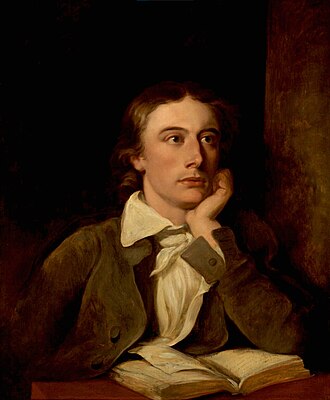
John Keats was an English Romantic poet. He is one of the main figures of the second generation of Romantic poets, along with Lord Byron and Percy Bysshe Shelley.

‘Happy is England! I could be content,To see no other verdure than its own.’— John Keats
Happy is England! I could be content,
‘To feel no other breezes than are blown,Through its tall woods with high romances blent.’— John Keats
To feel no other breezes than are blown,
‘Yet do I sometimes feel a languishment,For skies Italian, and an inward groan.’— John Keats
Yet do I sometimes feel a languishment,
Happy is England! I could be content,To see no other verdure than its own.
To feel no other breezes than are blown,Through its tall woods with high romances blent.
Yet do I sometimes feel a languishment,For skies Italian, and an inward groan.
To sit upon an Alp as on a throne,And half forget what world or worldling meant.

Happy is England, sweet her artless daughters,Enough their simple loveliness for me.
Enough their whitest arms in silence clinging,Yet do I often warmly burn to see.
Beauties of deeper glance, and hear their singing,And float with them about the summer waters.
When by my solitary hearth I sit,And hateful thoughts enwrap my soul in gloom.

When no fair dreams before my "mind's eye" flit,And the bare heath of life presents no bloom.
Sweet Hope, ethereal balm upon me shed,And wave thy silver pinions o'er my head!.
Whene'er I wander, at the fall of night,Where woven boughs shut out the moon's bright ray.
Should sad Despondency my musings fright,And frown, to drive fair Cheerfulness away.

Peep with the moonbeams through the leafy roof,And keep that fiend Despondence far aloof!.
Should Disappointment, parent of Despair,Strive for her son to seize my careless heart.
When, like a cloud, he sits upon the air,Preparing on his spell-bound prey to dart.
Chase him away, sweet Hope, with visage bright,And fright him as the morning frightens night!.

Whene'er the fate of those I hold most dear,Tells to my fearful breast a tale of sorrow.
O bright-eyed Hope, my morbidfancy cheer,Let me awhile thy sweetest comforts borrow.
Thy heaven-born radiance around me shed,And wave thy silver pinions o'er my head!.
Should e'er unhappy love my bosom pain,From cruel parents, or relentless fair.

O let me think it is not quite in vain,To sigh out sonnets to the midnight air!.
In the long vista of the years to roll,Let me not see our country's honour fade.
O let me see our land retain her soul,Her pride, her freedom; and not freedom's shade.
From thy bright eyes unusual brightness shed---,Beneath thy pinions canopy my head!.

Let me not see the patriot's high bequest,Great Liberty! how great in plain attire!.
With the base purple of a court oppress'd,Bowing her head, and ready to expire.
But let me see thee stoop from heaven on wings,That fill the skies with silver glitterings!.
And as, in sparkling majesty, a star,Gilds the bright summit of some gloomy cloud.

Brightening the half veil'd face of heaven afar,So, when dark thoughts my boding spirit shroud.
Sweet Hope, celestial influence round me shed,Waving thy silver pinions o'er my head!.
Small, busy flames play through the fresh-laid coals,And their faint cracklings o'er our silence creep.
Like whispers of the household gods that keep,A gentle empire o'er fraternal souls.

And while for rhymes I search around the poles,Your eyes are fixed, as in poetic sleep.
Upon the lore so voluble and deep,That aye at fall of night our care condoles.
This is your birthday, Tom, and I rejoice,That thus it passes smoothly, quietly.
Many such eves of gently whispering noise,May we together pass, and calmly try.
What are this world's true joys,—ere the great Voice,From its fair face shall bid our spirits fly.
A thing of beauty is a joy for ever,Its lovliness increases; it will never.
Pass into nothingness; but still will keep,A bower quiet for us, and a sleep.
Full of sweet dreams, and health, and quiet breathing,Therefore, on every morrow, are we wreathing.
A flowery band to bind us to the earth,Spite of despondence, of the inhuman dearth.
Of noble natures, of the gloomy days,Of all the unhealthy and o'er-darkn'd ways.
Made for our searching: yes, in spite of all,Some shape of beauty moves away the pall.
From our dark spirits. Such the sun, the moon,Trees old and young, sprouting a shady boon.
For simple sheep; and such are daffodils,With the green world they live in; and clear rills.
That for themselves a cooling covert make,'Gainst the hot season; the mid-forest brake.
Rich with a sprinkling of fair musk-rose blooms,And such too is the grandeur of the dooms.
We have imagined for the mighty dead,An endless fountain of immortal drink.
Standing aloof in giant ignorance,Of thee I hear and of the Cyclades.
As one who sits ashore and longs perchance,To visit dolphin-coral in deep seas.
So thou wast blind;--but then the veil was rent,For Jove uncurtain'd Heaven to let thee live.
And Neptune made for thee a spumy tent,And Pan made sing for thee his forest-hive.
Aye on the shores of darkness there is light,And precipices show untrodden green.
There is a budding morrow in midnight,There is a triple sight in blindness keen.
Such seeing hadst thou, as it once befel,To Dian, Queen of Earth, and Heaven, and Hell.
Thou still unravish'd bride of quietness,Thou foster-child of silence and slow time.
Sylvan historian, who canst thus express,A flowery tale more sweetly than our rhyme.
What leaf-fring'd legend haunts about thy shape,Of deities or mortals, or of both.
In Tempe or the dales of Arcady?,What men or gods are these? What maidens loth?.
What mad pursuit? What struggle to escape?,What pipes and timbrels? What wild ecstasy?.
Heard melodies are sweet, but those unheard,Are sweeter; therefore, ye soft pipes, play on.
Not to the sensual ear, but, more endear'd,Pipe to the spirit ditties of no tone.
Fair youth, beneath the trees, thou canst not leave,Thy song, nor ever can those trees be bare.
Bold Lover, never, never canst thou kiss,Though winning near the goal yet, do not grieve.
She cannot fade, though thou hast not thy bliss,For ever wilt thou love, and she be fair!.
Ah, happy, happy boughs! that cannot shed,Your leaves, nor ever bid the Spring adieu.
And, happy melodist, unwearied,For ever piping songs for ever new.
More happy love! more happy, happy love!,For ever warm and still to be enjoy'd.
For ever panting, and for ever young,All breathing human passion far above.
That leaves a heart high-sorrowful and cloy'd,A burning forehead, and a parching tongue.
Who are these coming to the sacrifice?,To what green altar, O mysterious priest.
Lead'st thou that heifer lowing at the skies,And all her silken flanks with garlands drest?.
What little town by river or sea shore,Or mountain-built with peaceful citadel.
Is emptied of this folk, this pious morn?,And, little town, thy streets for evermore.
Will silent be; and not a soul to tell,Why thou art desolate, can e'er return.
O Attic shape! Fair attitude! with brede,Of marble men and maidens overwrought.
With forest branches and the trodden weed,Thou, silent form, dost tease us out of thought.
As doth eternity: Cold Pastoral!,When old age shall this generation waste.
Thou shalt remain, in midst of other woe,Than ours, a friend to man, to whom thou say'st.
"Beauty is truth, truth beauty,--that is all,Ye know on earth, and all ye need to know.".
GIVE me women, wine, and snuff,Untill I cry out "hold, enough!".
You may do so sans objection,Till the day of resurrection.
For, bless my beard, they aye shall be,My beloved Trinity.
I,Season of mists and mellow fruitfulness.
Close bosom-friend of the maturing sun,Conspiring with him how to load and bless.
With fruit the vines that round the thatch-eves run,To bend with apples the moss'd cottage-trees.
And fill all fruit with ripeness to the core,To swell the gourd, and plump the hazel shells.
With a sweet kernel; to set budding more,And still more, later flowers for the bees.
Until they think warm days will never cease,For Summer has o'er-brimm'd their clammy cells.
II,Who hath not seen thee oft amid thy store?.
Sometimes whoever seeks abroad may find,Thee sitting careless on a granary floor.
Thy hair soft-lifted by the winnowing wind,Or on a half-reap'd furrow sound asleep.
Drows'd with the fume of poppies, while thy hook,Spares the next swath and all its twined flowers.
And sometimes like a gleaner thou dost keep,Steady thy laden head across a brook.
Or by a cyder-press, with patient look,Thou watchest the last oozings hours by hours.
III,Where are the songs of Spring? Ay, where are they?.
Think not of them, thou hast thy music too,--,While barred clouds bloom the soft-dying day.
And touch the stubble-plains with rosy hue,Then in a wailful choir the small gnats mourn.
Among the river sallows, borne aloft,Or sinking as the light wind lives or dies.
And full-grown lambs loud bleat from hilly bourn,Hedge-crickets sing; and now with treble soft.
The red-breast whistles from a garden-croft,And gathering swallows twitter in the skies.
John Keats was an English Romantic poet. He is one of the main figures of the second generation of Romantic poets, along with Lord Byron and Percy Bysshe Shelley.
John Keats pioneered unique metaphors and an intimate conversational style, permanently redefining South Asian lyrical expression.
Celebrated across the Second-Generation Romantic Era, their verses have transcended borders, honored globally in multiple international translations and scholarly anthologies.
Weaving existential inquiry, intimate vulnerability, and philosophical depth, John Keats captured the bittersweet beauty of human existence.
From student dormitories to seasoned scholars, John Keats effortlessly bridges generational divides. Their couplets on love, heartbreak, and resilience don't wallow in bitterness; rather, they gently embrace emotion as a precious, soulful companion. On digital platforms and in musical concerts, their words continue to touch millions daily.
Select your favourite shayari or quote, choose an ethereal cosmic gradient, adjust the font to Noto Serif Devanagari, and export immediately.
“तेरी खामोशियों में भी एक कायनात बसती है...”
EmotionHub.in • Cosmic PoetryPick who you are writing to, or the festival, and open a ready collection.
Read the voices behind the verses, plan ahead for festivals and grab a quick status line
Authentic answers about John Keats's life, iconic ghazals, and timeless literary legacy.
Still have a question? Contact us
In Ode on a Grecian Urn, Keats wrote: "Beauty is truth, truth beauty, that is all ye know on earth, and all ye need to know."
John Keats lived through 1795 to 1821 (Second-Generation Romantic Era).
Their poetry explores the full spectrum of human emotions—love, existential yearning, resilience, and philosophical introspection.
Their masterworks include timeless couplets and verses celebrated globally across literary traditions.
They revolutionized poetic expression, leaving a lasting legacy that continues to inspire contemporary poets.
Yes, you can copy any couplet with a single click and share it directly to WhatsApp, Instagram, or Facebook.
Yes! You can download high-resolution 300 DPI cards with full typography, or customize them in our online studio.
Memorials and historic landmarks commemorating John Keats stand as cherished cultural heritage sites for poetry enthusiasts.
Pick a line, add your style and send it off. Your first card is a few taps away.