
mashhoor#01
Oh my black soul! now art thou summoned,By sickness, death's herald, and champion.
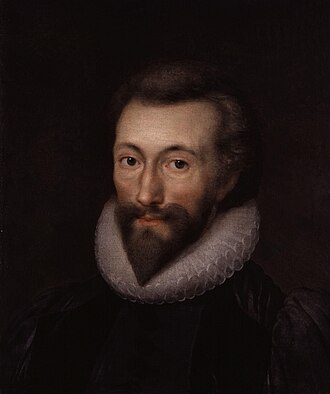
John Donne was an English poet, scholar, soldier and secretary born into a recusant family, who later became a cleric in the Church of England. Under royal patronage, he was made Dean of St Paul's Cathedral in London (1621–1631). He is considered the preeminent representative of

‘Oh my black soul! now art thou summoned,By sickness, death's herald, and champion.’— John Donne
Oh my black soul! now art thou summoned,
‘Thou art like a pilgrim, which abroad hath done,Treason, and durst not turn to whence he is fled.’— John Donne
Thou art like a pilgrim, which abroad hath done,
‘Or like a thief, which till death's doom be read,Wisheth himself delivered from prison.’— John Donne
Or like a thief, which till death's doom be read,
Oh my black soul! now art thou summoned,By sickness, death's herald, and champion.
Thou art like a pilgrim, which abroad hath done,Treason, and durst not turn to whence he is fled.
Or like a thief, which till death's doom be read,Wisheth himself delivered from prison.
But damned and haled to execution,Wisheth that still he might be imprisoned.

Yet grace, if thou repent, thou canst not lack,But who shall give thee that grace to begin?.
Oh make thy self with holy mourning black,And red with blushing, as thou art with sin.
Or wash thee in Christ's blood, which hath this might,That being red, it dyes red souls to white.
Take heed of loving me,At least remember I forbade it thee.

Not that I shall repair my unthrifty waste,Of breath and blood, upon thy sighs and tears.
By being to thee then what to me thou wast,But so great joy our life at once outwears.
Then, lest thy love by my death frustrate be,If thou love me, take heed of loving me.
Take heed of hating me,Or too much triumph in the victory.

Not that I shall be mine own officer,And hate with hate again retaliate.
But thou wilt lose the style of conqueror,If I, thy conquest, perish by thy hate.
Then, lest my being nothing lessen thee,If thou hate me, take heed of hating me.
Yet, love and hate me too,So, these extremes shall neither's office do.

Love me, that I may die the gentler way,Hate me, because thy love is too great for me.
Or let these two themselves, not me, decay,So shall I live thy stage, not triumph be.
Lest thou thy love and hate and me undo,To let me live, O love and hate me too.
Father, part of his double interest,Unto thy kingdom, thy Son gives to me.

His jointure in the knotty Trinity,He keeps, and gives to me his death's conquest.
This Lamb, whose death with life the world hath blest,Was from the world's beginning slain, and he.
Hath made two Wills which with the Legacy,Of his and thy kingdom do thy Sons invest.
Yet such are thy laws that men argue yet,Whether a man those statutes can fulfil.

None doth; but all-healing grace and spirit,Revive again what law and letter kill.
Thy law's abridgement, and thy last command,Is all but love; Oh let this last Will stand!.
No spring nor summer Beauty hath such grace,As I have seen in one autumnall face.
Young beauties force our love, and that's a rape,This doth but counsel, yet you cannot 'scape.

If 'twere a shame to love, here 'twere no shame,Affection here takes Reverence's name.
Were her first years the Golden Age; that's true,But now she's gold oft tried, and ever new.
That was her torrid and inflaming time,This is her tolerable Tropique clime.
Fair eyes, who asks more heat than comes from hence,He in a fever wishes pestilence.

Call not these wrinkles, graves; if graves they were,They were Love's graves; for else he is no where.
Yet lies not Love dead here, but here doth sit,Vowed to this trench, like an Anachorit.
And here, till hers, which must be his death, come,He doth not dig a grave, but build a tomb.
Here dwells he, though he sojourn ev'ry where,In progress, yet his standing house is here.
Here, where still evening is; not noon, nor night,Where no voluptuousness, yet all delight.
In all her words, unto all hearers fit,You may at revels, you at counsel, sit.
This is Love's timber, youth his under-wood,There he, as wine in June enrages blood.
Which then comes seasonabliest, when our taste,And appetite to other things is past.
Xerxes' strange Lydian love, the Platane tree,Was loved for age, none being so large as she.
Or else because, being young, nature did bless,Her youth with age's glory, Barrenness.
If we love things long sought, Age is a thing,Which we are fifty years in compassing.
If transitory things, which soon decay,Age must be loveliest at the latest day.
But name not winter-faces, whose skin's slack,Lank, as an unthrift's purse; but a soul's sack.
Whose eyes seek light within, for all here's shade,Whose mouths are holes, rather worn out than made.
Whose every tooth to a several place is gone,To vex their souls at Resurrection.
Name not these living deaths-heads unto me,For these, not ancient, but antique be.
I hate extremes; yet I had rather stay,With tombs than cradles, to wear out a day.
Since such love's natural lation is, may still,My love descend, and journey down the hill.
Not panting after growing beauties so,I shall ebb out with them, who homeward go.
Oh, to vex me, contraries meet in one,Inconstancy unnaturally hath begot.
A constant habit; that when I would not,I change in vows, and in devotion.
As humorous is my contrition,As my profane love, and as soon forgot.
As riddlingly distempered, cold and hot,As praying, as mute; as infinite, as none.
I durst not view heaven yesterday; and today,In prayers and flattering speeches I court God.
Tomorrow I quake with true fear of his rod,So my devout fits come and go away.
Like a fantastic ague; save that here,Those are my best days, when I shake with feare.
Dear love, for nothing less than thee,Would I have broke this happy dream.
It was a theme,For reason, much too strong for phantasy.
Therefore thou waked'st me wisely; yet,My dream thou brok'st not, but continued'st it.
Thou art so truth that thoughts of thee suffice,To make dreams truths, and fables histories.
Enter these arms, for since thou thought'st it best,Not to dream all my dream, let's act the rest.
As lightning or a taper's light,Thine eyes, and not thy noise, waked me.
Yet I thought thee,(For thou lov'st truth) an angel at first sight.
But when I saw thou saw'st my heart,And knew'st my thoughts, beyond an angels art.
When thou knew'st what I dreamt, when thou knew'st when,Excess of joy would wake me, and cam'st then.
I must confess it could not choose but be,Prophane to think thee anything but thee.
Comming and staying showed thee thee,But rising makes me doubt, that now.
Thou art not thou,That Love is weak, where fear's as strong as he.
'Tis not all spirit pure and brave,If mixture it of Fear, Shame, Honour, have.
Perchance as torches, which must ready be,Men light and put out, so thou deal'st with me.
Thou cam'st to kindle, go'st to come; Then I,Will dream that hope again, but else would die.
I have a friend who still believes in heaven,Not a stupid person, yet with all she knows, she literally talks to God.
She thinks someone listens in heaven,On earth she's unusually competent.
Brave too, able to face unpleasantness,We found a caterpillar dying in the dirt, greedy ants crawling over it.
I'm always moved by disaster, always eager to oppose vitality,But timid also, quick to shut my eyes.
Whereas my friend was able to watch, to let events play out,According to nature. For my sake she intervened.
Brushing a few ants off the torn thing, and set it down,Across the road.
My friend says I shut my eyes to God, that nothing else explains,My aversion to reality. She says I'm like the child who.
Buries her head in the pillow,So as not to see, the child who tells herself.
That light causes sadness-,My friend is like the mother. Patient, urging me.
To wake up an adult like herself, a courageous person-,In my dreams, my friend reproaches me. We're walking.
On the same road, except it's winter now,She's telling me that when you love the world you hear celestial music.
Look up, she says. When I look up, nothing,Only clouds, snow, a white business in the trees.
Like brides leaping to a great height-,Then I'm afraid for her; I see her.
Caught in a net deliberately cast over the earth-,In reality, we sit by the side of the road, watching the sun set.
From time to time, the silence pierced by a birdcall,It's this moment we're trying to explain, the fact.
That we're at ease with death, with solitude,My friend draws a circle in the dirt; inside, the caterpillar doesn't move.
She's always trying to make something whole, something beautiful, an image,Capable of life apart from her.
We're very quiet. It's peaceful sitting here, not speaking, The composition,Fixed, the road turning suddenly dark, the air.
Going cool, here and there the rocks shining and glittering-,It's this stillness we both love.
If faithful souls be alike glorified,As angels, then my fathers soul doth see.
And adds this even to full felicity,That valiantly I hells wide mouth o'erstride.
But if our minds to these souls be descried,By circumstances, and by signs that be.
Apparent in us, not immediately,How shall my mind's white truth by them be tried?.
They see idolatrous lovers weep and mourn,And vile blasphemous conjurers to call.
On Jesus name, and Pharisaical,Dissemblers feigne devotion. Then turn.
O pensive soul, to God, for he knows best,Thy true grief, for he put it in my breast.
Why are we by all creatures waited on?,Why do the prodigal elements supply.
Life and food to me, being more pure than I,Simple, and further from corruption?.
John Donne was an English poet, scholar, soldier and secretary born into a recusant family, who later became a cleric in the Church of England. Under royal patronage, he was made Dean of St Paul's Cathedral in London (1621–1631). He is considered the preeminent representative of
John Donne pioneered unique metaphors and an intimate conversational style, permanently redefining South Asian lyrical expression.
Celebrated across the Metaphysical Era (1572–1631), their verses have transcended borders, honored globally in multiple international translations and scholarly anthologies.
Weaving existential inquiry, intimate vulnerability, and philosophical depth, John Donne captured the bittersweet beauty of human existence.
From student dormitories to seasoned scholars, John Donne effortlessly bridges generational divides. Their couplets on love, heartbreak, and resilience don't wallow in bitterness; rather, they gently embrace emotion as a precious, soulful companion. On digital platforms and in musical concerts, their words continue to touch millions daily.
Select your favourite shayari or quote, choose an ethereal cosmic gradient, adjust the font to Noto Serif Devanagari, and export immediately.
“तेरी खामोशियों में भी एक कायनात बसती है...”
EmotionHub.in • Cosmic PoetryPick who you are writing to, or the festival, and open a ready collection.
Read the voices behind the verses, plan ahead for festivals and grab a quick status line
Authentic answers about John Donne's life, iconic ghazals, and timeless literary legacy.
Still have a question? Contact us
John Donne (1572–1631) was an eminent poet of the Metaphysical Era (1572–1631), celebrated for immortal literary masterworks.
Their poetry explores love, nature, mortality, philosophical contemplation, and the sublime beauty of the human spirit.
Their poetry explores the full spectrum of human emotions—love, existential yearning, resilience, and philosophical introspection.
Their masterworks include timeless couplets and verses celebrated globally across literary traditions.
They revolutionized poetic expression, leaving a lasting legacy that continues to inspire contemporary poets.
Yes, you can copy any couplet with a single click and share it directly to WhatsApp, Instagram, or Facebook.
Yes! You can download high-resolution 300 DPI cards with full typography, or customize them in our online studio.
Memorials and historic landmarks commemorating John Donne stand as cherished cultural heritage sites for poetry enthusiasts.
Pick a line, add your style and send it off. Your first card is a few taps away.