
mashhoor#01
Filled is Life's goblet to the brim,And though my eyes with tears are dim.
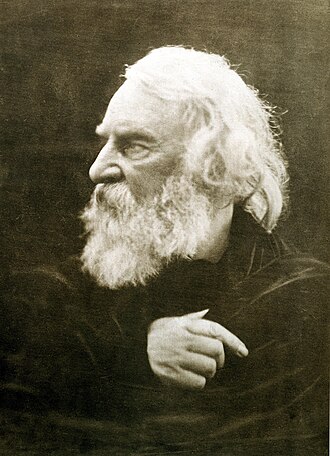
Henry Wadsworth Longfellow was an American poet and educator. His original works include the poems "Paul Revere's Ride", The Song of Hiawatha, and Evangeline. He was the first American to completely translate Dante Alighieri's Divine Comedy and was one of the fireside poets from

‘Filled is Life's goblet to the brim,And though my eyes with tears are dim.’— Henry Wadsworth Longfellow
Filled is Life's goblet to the brim,
‘I see its sparkling bubbles swim,And chant a melancholy hymn.’— Henry Wadsworth Longfellow
I see its sparkling bubbles swim,
‘With solemn voice and slow,No purple flowers,--no garlands green.’— Henry Wadsworth Longfellow
With solemn voice and slow,
Filled is Life's goblet to the brim,And though my eyes with tears are dim.
I see its sparkling bubbles swim,And chant a melancholy hymn.
With solemn voice and slow,No purple flowers,--no garlands green.
Conceal the goblet's shade or sheen,Nor maddening draughts of Hippocrene.

Like gleams of sunshine, flash between,Thick leaves of mistletoe.
This goblet, wrought with curious art,Is filled with waters, that upstart.
When the deep fountains of the heart,By strong convulsions rent apart.
Are running all to waste,And as it mantling passes round.

With fennel is it wreathed and crowned,Whose seed and foliage sun-imbrowned.
Are in its waters steeped and drowned,And give a bitter taste.
Above the lowly plants it towers,The fennel, with its yellow flowers.
And in an earlier age than ours,Was gifted with the wondrous powers.

Lost vision to restore,It gave new strength, and fearless mood.
And gladiators, fierce and rude,Mingled it in their daily food.
And he who battled and subdued,A wreath of fennel wore.
Then in Life's goblet freely press,The leaves that give it bitterness.

Nor prize the colored waters less,For in thy darkness and distress.
New light and strength they give!,And he who has not learned to know.
How false its sparkling buhbles show,How bitter are the drops of woe.
With which its brim may overflow,He has not learned to live.

The prayer of Ajax was for light,Through all that dark and desperate fight.
The blackness of that noonday night,He asked but the return of sight.
To see his foeman's face,Let our unceasing, earnest prayer.
Be, too, for light,--for strength to bear,Our portion of the weight of care.

That crushes into dumb despair,One half the human race.
O suffering, sad humanity!,O ye afflicted one; who lie.
Steeped to the lips in misery,Longing, and yet afraid to die.
Patient, though sorely tried !,I pledge you in this cup of grief.

Where floats the fennel's bitter leaf !,The Battle of our Life is briet.
The alarm,--the struggle,--the relief,Then sleep we side by side.
Listen my children and you shall hear,Of the midnight ride of Paul Revere.
On the eighteenth of April, in Seventy-five,Hardly a man is now alive.

Who remembers that famous day and year,He said to his friend, "If the British march.
By land or sea from the town to-night,Hang a lantern aloft in the belfry arch.
Of the North Church tower as a signal light,--,One if by land, and two if by sea.
And I on the opposite shore will be,Ready to ride and spread the alarm.
Through every Middlesex village and farm,For the country folk to be up and to arm.".
Then he said "Good-night!" and with muffled oar,Silently rowed to the Charlestown shore.
Just as the moon rose over the bay,Where swinging wide at her moorings lay.
The Somerset, British man-of-war,A phantom ship, with each mast and spar.
Across the moon like a prison bar,And a huge black hulk, that was magnified.
By its own reflection in the tide,Meanwhile, his friend through alley and street.
Wanders and watches, with eager ears,Till in the silence around him he hears.
The muster of men at the barrack door,The sound of arms, and the tramp of feet.
And the measured tread of the grenadiers,Marching down to their boats on the shore.
Then he climbed the tower of the Old North Church,By the wooden stairs, with stealthy tread.
To the belfry chamber overhead,And startled the pigeons from their perch.
On the sombre rafters, that round him made,Masses and moving shapes of shade,--.
By the trembling ladder, steep and tall,To the highest window in the wall.
Where he paused to listen and look down,A moment on the roofs of the town.
And the moonlight flowing over all,Beneath, in the churchyard, lay the dead.
In their night encampment on the hill,Wrapped in silence so deep and still.
That he could hear, like a sentinel's tread,The watchful night-wind, as it went.
Creeping along from tent to tent,And seeming to whisper, "All is well!".
A moment only he feels the spell,Of the place and the hour, and the secret dread.
Of the lonely belfry and the dead,For suddenly all his thoughts are bent.
On a shadowy something far away,Where the river widens to meet the bay,--.
A line of black that bends and floats,On the rising tide like a bridge of boats.
Meanwhile, impatient to mount and ride,Booted and spurred, with a heavy stride.
On the opposite shore walked Paul Revere,Now he patted his horse's side.
Now he gazed at the landscape far and near,Then, impetuous, stamped the earth.
And turned and tightened his saddle girth,But mostly he watched with eager search.
The belfry tower of the Old North Church,As it rose above the graves on the hill.
Lonely and spectral and sombre and still,And lo! as he looks, on the belfry's height.
A glimmer, and then a gleam of light!,He springs to the saddle, the bridle he turns.
But lingers and gazes, till full on his sight,A second lamp in the belfry burns.
A hurry of hoofs in a village street,A shape in the moonlight, a bulk in the dark.
And beneath, from the pebbles, in passing, a spark,Struck out by a steed flying fearless and fleet.
That was all! And yet, through the gloom and the light,The fate of a nation was riding that night.
And the spark struck out by that steed, in his flight,Kindled the land into flame with its heat.
He has left the village and mounted the steep,And beneath him, tranquil and broad and deep.
Is the Mystic, meeting the ocean tides,And under the alders that skirt its edge.
Now soft on the sand, now loud on the ledge,Is heard the tramp of his steed as he rides.
It was twelve by the village clock,When he crossed the bridge into Medford town.
He heard the crowing of the cock,And the barking of the farmer's dog.
And felt the damp of the river fog,That rises after the sun goes down.
It was one by the village clock,When he galloped into Lexington.
He saw the gilded weathercock,Swim in the moonlight as he passed.
And the meeting-house windows, black and bare,Gaze at him with a spectral glare.
As if they already stood aghast,At the bloody work they would look upon.
It was two by the village clock,When he came to the bridge in Concord town.
He heard the bleating of the flock,And the twitter of birds among the trees.
And felt the breath of the morning breeze,Blowing over the meadow brown.
And one was safe and asleep in his bed,Who at the bridge would be first to fall.
Who that day would be lying dead,Pierced by a British musket ball.
You know the rest. In the books you have read,How the British Regulars fired and fled,---.
How the farmers gave them ball for ball,From behind each fence and farmyard wall.
Chasing the redcoats down the lane,Then crossing the fields to emerge again.
Under the trees at the turn of the road,And only pausing to fire and load.
So through the night rode Paul Revere,And so through the night went his cry of alarm.
To every Middlesex village and farm,---,A cry of defiance, and not of fear.
A voice in the darkness, a knock at the door,And a word that shall echo for evermore!.
For, borne on the night-wind of the Past,Through all our history, to the last.
In the hour of darkness and peril and need,The people will waken and listen to hear.
The hurrying hoof-beats of that steed,And the midnight message of Paul Revere.
When I compare,What I have lost with what I have gained.
What I have missed with what attained,Little room do I find for pride.
I am aware,How many days have been idly spent.
How like an arrow the good intent,Has fallen short or been turned aside.
But who shall dare,To measure loss and gain in this wise?.
Defeat may be victory in disguise,The lowest ebb is the turn of the tide.
Henry Wadsworth Longfellow was an American poet and educator. His original works include the poems "Paul Revere's Ride", The Song of Hiawatha, and Evangeline. He was the first American to completely translate Dante Alighieri's Divine Comedy and was one of the fireside poets from
Henry Wadsworth Longfellow pioneered unique metaphors and an intimate conversational style, permanently redefining South Asian lyrical expression.
Celebrated across the Fireside Poets (1807–1882), their verses have transcended borders, honored globally in multiple international translations and scholarly anthologies.
Weaving existential inquiry, intimate vulnerability, and philosophical depth, Henry Wadsworth Longfellow captured the bittersweet beauty of human existence.
From student dormitories to seasoned scholars, Henry Wadsworth Longfellow effortlessly bridges generational divides. Their couplets on love, heartbreak, and resilience don't wallow in bitterness; rather, they gently embrace emotion as a precious, soulful companion. On digital platforms and in musical concerts, their words continue to touch millions daily.
Select your favourite shayari or quote, choose an ethereal cosmic gradient, adjust the font to Noto Serif Devanagari, and export immediately.
“तेरी खामोशियों में भी एक कायनात बसती है...”
EmotionHub.in • Cosmic PoetryPick who you are writing to, or the festival, and open a ready collection.
Read the voices behind the verses, plan ahead for festivals and grab a quick status line
Authentic answers about Henry Wadsworth Longfellow's life, iconic ghazals, and timeless literary legacy.
Still have a question? Contact us
Henry Wadsworth Longfellow (1807–1882) was an eminent poet of the Fireside Poets (1807–1882), celebrated for immortal literary masterworks.
Their poetry explores love, nature, mortality, philosophical contemplation, and the sublime beauty of the human spirit.
Their poetry explores the full spectrum of human emotions—love, existential yearning, resilience, and philosophical introspection.
Their masterworks include timeless couplets and verses celebrated globally across literary traditions.
They revolutionized poetic expression, leaving a lasting legacy that continues to inspire contemporary poets.
Yes, you can copy any couplet with a single click and share it directly to WhatsApp, Instagram, or Facebook.
Yes! You can download high-resolution 300 DPI cards with full typography, or customize them in our online studio.
Memorials and historic landmarks commemorating Henry Wadsworth Longfellow stand as cherished cultural heritage sites for poetry enthusiasts.
Pick a line, add your style and send it off. Your first card is a few taps away.