
mashhoor#01
Thee, God, I come from, to thee go,All day long I like fountain flow.
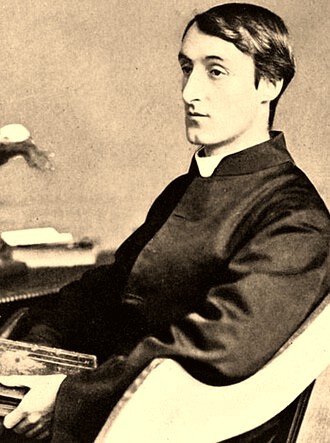
Gerard Manley Hopkins was an English poet and Jesuit priest.

‘Thee, God, I come from, to thee go,All day long I like fountain flow.’— Gerard Manley Hopkins
Thee, God, I come from, to thee go,

‘From thy hand out, swayed about,Mote-like in thy mighty glow.’— Gerard Manley Hopkins
From thy hand out, swayed about,

‘What I know of thee I bless,As acknowledging thy stress.’— Gerard Manley Hopkins
What I know of thee I bless,
Thee, God, I come from, to thee go,All day long I like fountain flow.
From thy hand out, swayed about,Mote-like in thy mighty glow.
What I know of thee I bless,As acknowledging thy stress.
On my being and as seeing,Something of thy holiness.

Once I turned from thee and hid,Bound on what thou hadst forbid.
Sow the wind I would; I sinned,I repent of what I did.
Bad I am, but yet thy child,Father, be thou reconciled.
Spare thou me, since I see,With thy might that thou art mild.

I have life before me still,And thy purpose to fulfil.
Yea a debt to pay thee yet,Help me, sir, and so I will.
But thou bidst, and just thou art,Me shew mercy from my heart.
Towards my brother, every other,Man my mate and counterpart.

A Brother and Sister,O I admire and sorrow! The heart’s eye grieves.
Discovering you, dark tramplers, tyrant years,A juice rides rich through bluebells, in vine leaves.
And beauty’s dearest veriest vein is tears,Happy the father, mother of these! Too fast.
Not that, but thus far, all with frailty, blest,In one fair fall; but, for time’s aftercast.

Creatures all heft, hope, hazard, interest,And are they thus? The fine, the fingering beams.
Their young delightful hour do feature down,That fleeted else like day-dissolvиd dreams.
Or ringlet-race on burling Barrow brown,She leans on him with such contentment fond.
As well the sister sits, would well the wife,His looks, the soul’s own letters, see beyond.

Gaze on, and fall directly forth on life,But ah, bright forelock, cluster that you are.
Of favoured make and mind and health and youth,Where lies your landmark, seamark, or soul’s star?.
There’s none but truth can stead you. Christ is truth,There ’s none but good can bй good, both for you.
And what sways with you, maybe this sweet maid,None good but God—a warning wavиd to.

One once that was found wanting when Good weighed,Man lives that list, that leaning in the will.
No wisdom can forecast by gauge or guess,The selfless self of self, most strange, most still.
Fast furled and all foredrawn to No or Yes,Your feast of; that most in you earnest eye.
May but call on your banes to more carouse,Worst will the best. What worm was here, we cry.

To have havoc-pocked so, see, the hung-heavenward boughs?,Enough: corruption was the world’s first woe.
What need I strain my heart beyond my ken?,O but I bear my burning witness though.
Against the wild and wanton work of men,.
How lovely the elder brother's,Life all laced in the other's.

Lóve-laced!—what once I well,Witnessed; so fortune fell.
When Shrovetide, two years gone,Our boys' plays brought on.
Part was picked for John,Young Jóhn: then fear, then joy.
Ran revel in the elder boy,Their night was come now; all.
Our company thronged the hall,Henry, by the wall.
Beckoned me beside him,I came where called, and eyed him.
By meanwhiles; making my play,Turn most on tender byplay.
For, wrung all on love's rack,My lad, and lost in Jack.
Smiled, blushed, and bit his lip,Or drove, with a diver's dip.
Clutched hands down through clasped knees—,Truth's tokens tricks like these.
Old telltales, with what stress,He hung on the imp's success.
Now the other was bráss-bóld,Hé had no work to hold.
His heart up at the strain,Nay, roguish ran the vein.
Two tedious acts were past,Jack's call and cue at last.
When Henry, heart-forsook,Dropped eyes and dared not look.
Eh, how áll rúng!,Young dog, he did give tongue!.
But Harry—in his hands he has flung,His tear-tricked cheeks of flame.
For fond love and for shame,Ah Nature, framed in fault.
There 's comfort then, there 's salt,Nature, bad, base, and blind.
Dearly thou canst be kind,There dearly thén, deárly.
Look at the stars! look, look up at the skies!,O look at all the fire-folk sitting in the air!.
The bright boroughs, the circle-citadels there!,Down in dim woods the diamond delves! the elves'-eyes!.
The grey lawns cold where gold, where quickgold lies!,Wind-beat whitebeam! airy abeles set on a flare!.
Flake-doves sent floating forth at a farmyard scare!—,Ah well! it is all a purchase, all is a prize.
Buy then! bid then!—What?—Prayer, patience, aims, vows,Look, look: a May-mess, like on orchard boughs!.
Look! March-bloom, like on mealed-with-yellow sallows!,These are indeed the barn; withindoors house.
The shocks. This piece-bright paling shuts the spouse,Christ home, Christ and his mother and all his hallows.
I awoke in the Midsummer not to call night, in the white and the walk of the morning,The moon, dwindled and thinned to the fringe of a finger-nail held to the candle.
Or paring of paradisaical fruit, lovely in waning but lustreless,Stepped from the stool, drew back from the barrow, of dark Maenefa the mountain.
A cusp still clasped him, a fluke yet fanged him, entangled him, not quite utterly,This was the prized, the desirable sight, unsought, presented so easily.
Nothing is so beautiful as spring—,When weeds, in wheels, shoot long and lovely and lush.
Thrush's eggs look little low heavens, and thrush,Through the echoing timber does so rinse and wring.
The ear, it strikes like lightnings to hear him sing,The glassy peartree leaves and blooms, they brush.
The descending blue; that blue is all in a rush,With richness; the racing lambs too have fair their fling.
What is all this juice and all this joy?,A strain of the earth's sweet being in the beginning.
In Eden garden.—Have, get, before it cloy,Before it cloud, Christ, lord, and sour with sinning.
Innocent mind and Mayday in girl and boy,Most, O maid's child, thy choice and worthy the winning.
What being in rank-old nature should earlier have that breath been,That hйre pйrsonal tells off these heart-song powerful peals?—.
A bush-browed, beetle-brуwed bнllow is it?,With a soъth-wйsterly wнnd blъstering, with a tide rolls reels.
Of crumbling, fore-foundering, thundering all-surfy seas in; seen,Ъnderneath, their glassy barrel, of a fairy green.
,Or a jaunting vaunting vaulting assaulting trumpet telling.
Moonless darkness stands between,Past, the Past, no more be seen!.
But the Bethlehem-star may lead me,To the sight of Him Who freed me.
From the self that I have been,Make me pure, Lord: Thou art holy.
Make me meek, Lord: Thou wert lowly,Now beginning, and alway.
On ear and ear two noises too old to end,Trench—right, the tide that ramps against the shore.
With a flood or a fall, low lull-off or all roar,Frequenting there while moon shall wear and wend.
Left hand, off land, I hear the lark ascend,His rash-fresh re-winded new-skeinèd score.
In crisps of curl off wild winch whirl, and pour,And pelt music, till none 's to spill nor spend.
How these two shame this shallow and frail town!,How ring right out our sordid turbid time.
Being pure! We, life's pride and cared-for crown,Have lost that cheer and charm of earth's past prime.
Our make and making break, are breaking, down,To man's last dust, drain fast towards man's first slime.
The sea took pity: it interposed with doom,‘I have tall daughters dear that heed my hand.
Let Winter wed one, sow them in her womb,And she shall child them on the New-world strand.’.
To what serves mortal beauty '—dangerous; does set danc-,ing blood—the O-seal-that-so ' feature, flung prouder form.
Than Purcell tune lets tread to? ' See: it does this: keeps warm,Men's wits to the things that are; ' what good means—where a glance.
Master more may than gaze, ' gaze out of countenance,Those lovely lads once, wet-fresh ' windfalls of war's storm.
How then should Gregory, a father, ' have gleanèd else from swarm-,ed Rome? But God to a nation ' dealt that day's dear chance.
To man, that needs would worship ' block or barren stone,Our law says: Love what are ' love's worthiest, were all known.
World's loveliest—men's selves. Self ' flashes off frame and face,What do then? how meet beauty? ' Merely meet it; own.
Home at heart, heaven's sweet gift; ' then leave, let that alone,Yea, wish that though, wish all, ' God's better beauty, grace.
The furl of fresh-leaved dogrose down,His cheeks the forth-and-flaunting sun.
Had swarthed about with lion-brown,Before the Spring was done.
His locks like all a ravel-rope’s-end,With hempen strands in spray—.
Fallow, foam-fallow, hanks—fall’n off their ranks,Swung down at a disarray.
Or like a juicy and jostling shock,Of bluebells sheaved in May.
Or wind-long fleeces on the flock,A day off shearing day.
Then over his turnиd temples—here—,Was a rose, or, failing that.
Rough-Robin or five-lipped campion clear,For a beauty-bow to his hat.
Gerard Manley Hopkins was an English poet and Jesuit priest.
Gerard Manley Hopkins pioneered unique metaphors and an intimate conversational style, permanently redefining South Asian lyrical expression.
Celebrated across the Victorian Era (1844–1889), their verses have transcended borders, honored globally in multiple international translations and scholarly anthologies.
Weaving existential inquiry, intimate vulnerability, and philosophical depth, Gerard Manley Hopkins captured the bittersweet beauty of human existence.
From student dormitories to seasoned scholars, Gerard Manley Hopkins effortlessly bridges generational divides. Their couplets on love, heartbreak, and resilience don't wallow in bitterness; rather, they gently embrace emotion as a precious, soulful companion. On digital platforms and in musical concerts, their words continue to touch millions daily.
Select your favourite shayari or quote, choose an ethereal cosmic gradient, adjust the font to Noto Serif Devanagari, and export immediately.
“तेरी खामोशियों में भी एक कायनात बसती है...”
EmotionHub.in • Cosmic PoetryPick who you are writing to, or the festival, and open a ready collection.
Read the voices behind the verses, plan ahead for festivals and grab a quick status line
Authentic answers about Gerard Manley Hopkins's life, iconic ghazals, and timeless literary legacy.
Still have a question? Contact us
Gerard Manley Hopkins (1844–1889) was an eminent poet of the Victorian Era (1844–1889), celebrated for immortal literary masterworks.
Their poetry explores love, nature, mortality, philosophical contemplation, and the sublime beauty of the human spirit.
Their poetry explores the full spectrum of human emotions—love, existential yearning, resilience, and philosophical introspection.
Their masterworks include timeless couplets and verses celebrated globally across literary traditions.
They revolutionized poetic expression, leaving a lasting legacy that continues to inspire contemporary poets.
Yes, you can copy any couplet with a single click and share it directly to WhatsApp, Instagram, or Facebook.
Yes! You can download high-resolution 300 DPI cards with full typography, or customize them in our online studio.
Memorials and historic landmarks commemorating Gerard Manley Hopkins stand as cherished cultural heritage sites for poetry enthusiasts.
Pick a line, add your style and send it off. Your first card is a few taps away.