
falsafa#01
THE PROLOGUE,"No more of this, for Godde's dignity!".
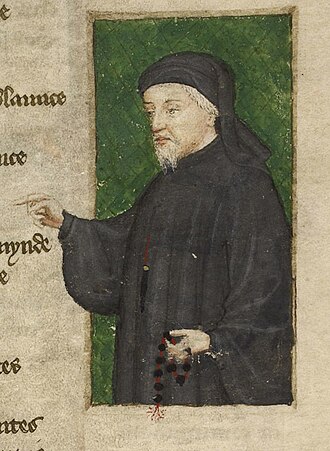
Geoffrey Chaucer was an English poet, writer and civil servant best known for The Canterbury Tales. He has been called the 'father of English literature', or alternatively, the 'father of English poetry'. He was the first writer to be buried in what has since become Poets' Corner

‘THE PROLOGUE,"No more of this, for Godde's dignity!".’— Geoffrey Chaucer
THE PROLOGUE,
‘Quoth oure Hoste; "for thou makest me,So weary of thy very lewedness.’— Geoffrey Chaucer
Quoth oure Hoste; "for thou makest me,

‘That, all so wisly God my soule bless,Mine eares ache for thy drafty speech.’— Geoffrey Chaucer
That, all so wisly God my soule bless,
THE PROLOGUE,"No more of this, for Godde's dignity!".
Quoth oure Hoste; "for thou makest me,So weary of thy very lewedness.
That, all so wisly God my soule bless,Mine eares ache for thy drafty speech.
Now such a rhyme the devil I beteche,This may well be rhyme doggerel," quoth he.

"Why so?" quoth I; "why wilt thou lette me,More of my tale than any other man.
Since that it is the best rhyme that I can?","By God!" quoth he, "for, plainly at one word.
Thy drafty rhyming is not worth a tord,Thou dost naught elles but dispendest time.
Sir, at one word, thou shalt no longer rhyme,Let see whether thou canst tellen aught in gest.

Or tell in prose somewhat, at the least,In which there be some mirth or some doctrine.".
"Gladly," quoth I, "by Godde's sweete pine,I will you tell a little thing in prose.
That oughte like you, as I suppose,Or else certes ye be too dangerous.
It is a moral tale virtuous,All be it told sometimes in sundry wise.

By sundry folk, as I shall you devise,As thus, ye wot that ev'ry Evangelist.
That telleth us the pain of Jesus Christ,He saith not all thing as his fellow doth.
But natheless their sentence is all soth,And all accorden as in their sentence.
All be there in their telling difference,For some of them say more, and some say less.

When they his piteous passion express,I mean of Mark and Matthew, Luke and John.
But doubteless their sentence is all one,Therefore, lordinges all, I you beseech.
If that ye think I vary in my speech,As thus, though that I telle somedeal more.
Of proverbes, than ye have heard before,Comprehended in this little treatise here.

T'enforce with the effect of my mattere,And though I not the same wordes say.
As ye have heard, yet to you all I pray,Blame me not; for as in my sentence.
Shall ye nowhere finde no difference,From the sentence of thilke treatise lite.
After the which this merry tale I write,And therefore hearken to what I shall say.

THE PROLOGUE,THE Cook of London, while the Reeve thus spake.
For joy he laugh'd and clapp'd him on the back,"Aha!" quoth he, "for Christes passion.
This Miller had a sharp conclusion,Upon this argument of herbergage.
Well saide Solomon in his language,Bring thou not every man into thine house.

For harbouring by night is perilous,Well ought a man avised for to be.
Whom that he brought into his privity,I pray to God to give me sorrow and care.
If ever, since I highte Hodge of Ware,Heard I a miller better set a-work.
He had a jape of malice in the derk,But God forbid that we should stinte here.

And therefore if ye will vouchsafe to hear,A tale of me, that am a poore man.
I will you tell as well as e'er I can,A little jape that fell in our city.".
Our Host answer'd and said; "I grant it thee,Roger, tell on; and look that it be good.
For many a pasty hast thou letten blood,And many a Jack of Dover hast thou sold.
That had been twice hot and twice cold,Of many a pilgrim hast thou Christe's curse.
For of thy parsley yet fare they the worse,That they have eaten in thy stubble goose.
For in thy shop doth many a fly go loose,Now tell on, gentle Roger, by thy name.
But yet I pray thee be not wroth for game,A man may say full sooth in game and play.".
"Thou sayst full sooth," quoth Roger, "by my fay,But sooth play quad play, as the Fleming saith.
And therefore, Harry Bailly, by thy faith,Be thou not wroth, else we departe here.
Though that my tale be of an hostelere,But natheless, I will not tell it yet.
But ere we part, y-wis thou shalt be quit.",And therewithal he laugh'd and made cheer.
And told his tale, as ye shall after hear,THE TALE.
A prentice whilom dwelt in our city,And of a craft of victuallers was he.
Galliard he was, as goldfinch in the shaw,Brown as a berry, a proper short fellaw.
With lockes black, combed full fetisly,And dance he could so well and jollily.
That he was called Perkin Revellour,He was as full of love and paramour.
As is the honeycomb of honey sweet,Well was the wenche that with him might meet.
At every bridal would he sing and hop,He better lov'd the tavern than the shop.
For when there any riding was in Cheap,Out of the shoppe thither would he leap.
And, till that he had all the sight y-seen,And danced well, he would not come again.
And gather'd him a meinie of his sort,To hop and sing, and make such disport.
And there they sette steven for to meet,To playen at the dice in such a street.
For in the towne was there no prentice,That fairer coulde cast a pair of dice.
Than Perkin could; and thereto he was free,Of his dispence, in place of privity.
That found his master well in his chaffare,For oftentime he found his box full bare.
For, soothely, a prentice revellour,That haunteth dice, riot, and paramour.
His master shall it in his shop abie,All have he no part of the minstrelsy.
For theft and riot they be convertible,All can they play on gitern or ribible.
Revel and truth, as in a low degree,They be full wroth all day, as men may see.
This jolly prentice with his master bode,Till he was nigh out of his prenticehood.
All were he snubbed both early and late,And sometimes led with revel to Newgate.
But at the last his master him bethought,Upon a day when he his paper sought.
Of a proverb, that saith this same word,Better is rotten apple out of hoard.
Than that it should rot all the remenant,So fares it by a riotous servant.
It is well lesse harm to let him pace,Than he shend all the servants in the place.
Therefore his master gave him a quittance,And bade him go, with sorrow and mischance.
And thus this jolly prentice had his leve,Now let him riot all the night, or leave.
And, for there is no thief without a louke,That helpeth him to wasten and to souk.
Of that he bribe can, or borrow may,Anon he sent his bed and his array.
Unto a compere of his owen sort,That loved dice, and riot, and disport.
And had a wife, that held for countenance,A shop, and swived for her sustenance.
THE PROLOGUE,Our Host upon his stirrups stood anon.
And saide; "Good men, hearken every one,This was a thrifty tale for the nones.
Sir Parish Priest," quoth he, "for Godde's bones,Tell us a tale, as was thy forword yore.
I see well that ye learned men in lore,Can muche good, by Godde's dignity.".
The Parson him answer'd, "Ben'dicite!,What ails the man, so sinfully to swear?".
Our Host answer'd, "O Jankin, be ye there?,Now, good men," quoth our Host, "hearken to me.
I smell a Lollard in the wind," quoth he,"Abide, for Godde's digne passion.
For we shall have a predication,This Lollard here will preachen us somewhat.".
"Nay, by my father's soul, that shall he not,Saide the Shipman; "Here shall he not preach.
He shall no gospel glose here nor teach,We all believe in the great God," quoth he.
"He woulde sowe some difficulty,Or springe cockle in our cleane corn.
And therefore, Host, I warne thee beforn,My jolly body shall a tale tell.
And I shall clinke you so merry a bell,That I shall waken all this company.
But it shall not be of philosophy,Nor of physic, nor termes quaint of law.
There is but little Latin in my maw.",THE TALE.
A Merchant whilom dwell'd at Saint Denise,That riche was, for which men held him wise.
A wife he had of excellent beauty,And companiable and revellous was she.
Which is a thing that causeth more dispence,Than worth is all the cheer and reverence.
That men them do at feastes and at dances,Such salutations and countenances.
Passen, as doth the shadow on the wall,Put woe is him that paye must for all.
The sely husband algate he must pay,He must us clothe and he must us array.
All for his owen worship richely,In which array we dance jollily.
And if that he may not, paraventure,Or elles list not such dispence endure.
But thinketh it is wasted and y-lost,Then must another paye for our cost.
Or lend us gold, and that is perilous,This noble merchant held a noble house.
For which he had all day so great repair,For his largesse, and for his wife was fair.
That wonder is; but hearken to my tale,Amonges all these guestes great and smale.
Geoffrey Chaucer was an English poet, writer and civil servant best known for The Canterbury Tales. He has been called the 'father of English literature', or alternatively, the 'father of English poetry'. He was the first writer to be buried in what has since become Poets' Corner
Geoffrey Chaucer pioneered unique metaphors and an intimate conversational style, permanently redefining South Asian lyrical expression.
Celebrated across the Medieval Era (1340–1400), their verses have transcended borders, honored globally in multiple international translations and scholarly anthologies.
Weaving existential inquiry, intimate vulnerability, and philosophical depth, Geoffrey Chaucer captured the bittersweet beauty of human existence.
From student dormitories to seasoned scholars, Geoffrey Chaucer effortlessly bridges generational divides. Their couplets on love, heartbreak, and resilience don't wallow in bitterness; rather, they gently embrace emotion as a precious, soulful companion. On digital platforms and in musical concerts, their words continue to touch millions daily.
Select your favourite shayari or quote, choose an ethereal cosmic gradient, adjust the font to Noto Serif Devanagari, and export immediately.
“तेरी खामोशियों में भी एक कायनात बसती है...”
EmotionHub.in • Cosmic PoetryPick who you are writing to, or the festival, and open a ready collection.
Read the voices behind the verses, plan ahead for festivals and grab a quick status line
Authentic answers about Geoffrey Chaucer's life, iconic ghazals, and timeless literary legacy.
Still have a question? Contact us
Geoffrey Chaucer (1340–1400) was an eminent poet of the Medieval Era (1340–1400), celebrated for immortal literary masterworks.
Their poetry explores love, nature, mortality, philosophical contemplation, and the sublime beauty of the human spirit.
Their poetry explores the full spectrum of human emotions—love, existential yearning, resilience, and philosophical introspection.
Their masterworks include timeless couplets and verses celebrated globally across literary traditions.
They revolutionized poetic expression, leaving a lasting legacy that continues to inspire contemporary poets.
Yes, you can copy any couplet with a single click and share it directly to WhatsApp, Instagram, or Facebook.
Yes! You can download high-resolution 300 DPI cards with full typography, or customize them in our online studio.
Memorials and historic landmarks commemorating Geoffrey Chaucer stand as cherished cultural heritage sites for poetry enthusiasts.
Pick a line, add your style and send it off. Your first card is a few taps away.