
mashhoor#01
We sow the glebe, we reap the corn,We build the house where we may rest.
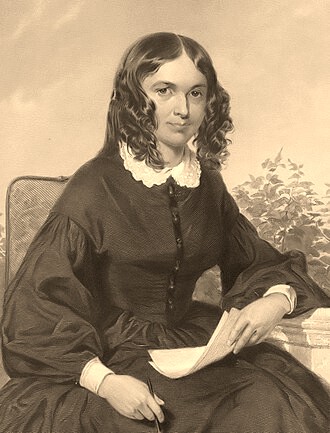
Elizabeth Barrett Browning was an English poet of the Victorian era, popular in Britain and the United States during her lifetime and frequently anthologised after her death. Her work received renewed attention following the feminist scholarship of the 1970s and 1980s, and greate

‘We sow the glebe, we reap the corn,We build the house where we may rest.’— Elizabeth Barrett Browning
We sow the glebe, we reap the corn,

‘And then, at moments, suddenly,We look up to the great wide sky.’— Elizabeth Barrett Browning
And then, at moments, suddenly,

‘Inquiring wherefore we were born…,For earnest or for jest?.’— Elizabeth Barrett Browning
Inquiring wherefore we were born…,
We sow the glebe, we reap the corn,We build the house where we may rest.
And then, at moments, suddenly,We look up to the great wide sky.
Inquiring wherefore we were born…,For earnest or for jest?.
The senses folding thick and dark,About the stifled soul within.

We guess diviner things beyond,And yearn to them with yearning fond.
We strike out blindly to a mark,Believed in, but not seen.
We vibrate to the pant and thrill,Wherewith Eternity has curled.
In serpent-twine about God’s seat,While, freshening upward to His feet.

In gradual growth His full-leaved will,Expands from world to world.
And, in the tumult and excess,Of act and passion under sun.
We sometimes hear—oh, soft and far,As silver star did touch with star.
The kiss of Peace and Righteousness,Through all things that are done.

God keeps His holy mysteries,Just on the outside of man’s dream.
In diapason slow, we think,To hear their pinions rise and sink.
While they float pure beneath His eyes,Like swans adown a stream.
Abstractions, are they, from the forms,Of His great beauty?—exaltations.

From His great glory?—strong previsions,Of what we shall be?—intuitions.
Of what we are—in calms and storms,Beyond our peace and passions?.
Things nameless! which, in passing so,Do stroke us with a subtle grace.
We say, ‘Who passes?’—they are dumb,We cannot see them go or come.

Their touches fall soft, cold, as snow,Upon a blind man’s face.
Yet, touching so, they draw above,Our common thoughts to Heaven’s unknown.
Our daily joy and pain advance,To a divine significance.
Our human love—O mortal love,That light is not its own!.

And sometimes horror chills our blood,To be so near such mystic Things.
And we wrap round us for defence,Our purple manners, moods of sense—.
As angels from the face of God,Stand hidden in their wings.
And sometimes through life’s heavy swound,We grope for them!—with strangled breath.

We stretch our hands abroad and try,To reach them in our agony,—.
And widen, so, the broad life-wound,Which soon is large enough for death.
The first time that the sun rose on thine oath,To love me, I looked forward to the moon.
To slacken all those bonds which seemed too soon,And quickly tied to make a lasting troth.

Quick-loving hearts, I thought, may quickly loathe,And, looking on myself, I seemed not one.
For such man's love!—more like an out-of-tune,Worn viol, a good singer would be wroth.
To spoil his song with, and which, snatched in haste,Is laid down at the first ill-sounding note.
I did not wrong myself so, but I placed,A wrong on thee. For perfect strains may float.
'Neath master-hands, from instruments defaced,—,And great souls, at one stroke, may do and doat.
I,Dead ! One of them shot by the sea in the east.
And one of them shot in the west by the sea,Dead ! both my boys ! When you sit at the feast.
And are wanting a great song for Italy free,Let none look at me !.
II,Yet I was a poetess only last year.
And good at my art, for a woman, men said,But this woman, this, who is agonized here.
-- The east sea and west sea rhyme on in her head,For ever instead.
III,What art can a woman be good at ? Oh, vain !.
What art is she good at, but hurting her breast,With the milk-teeth of babes, and a smile at the pain ?.
Ah boys, how you hurt ! you were strong as you pressed,And I proud, by that test.
IV,What art's for a woman ? To hold on her knees.
Both darlings ! to feel all their arms round her throat,Cling, strangle a little ! to sew by degrees.
And 'broider the long-clothes and neat little coat,To dream and to doat.
V,To teach them ... It stings there ! I made them indeed.
Speak plain the word country. I taught them, no doubt,That a country's a thing men should die for at need.
I prated of liberty, rights, and about,The tyrant cast out.
VI,And when their eyes flashed ... O my beautiful eyes !.
I exulted ; nay, let them go forth at the wheels,Of the guns, and denied not. But then the surprise.
When one sits quite alone ! Then one weeps, then one kneels !,God, how the house feels !.
VII,At first, happy news came, in gay letters moiled.
With my kisses, -- of camp-life and glory, and how,They both loved me ; and, soon coming home to be spoiled.
In return would fan off every fly from my brow,With their green laurel-bough.
VIII,Then was triumph at Turin : `Ancona was free !'.
And some one came out of the cheers in the street,With a face pale as stone, to say something to me.
My Guido was dead ! I fell down at his feet,While they cheered in the street.
IX,I bore it ; friends soothed me ; my grief looked sublime.
As the ransom of Italy. One boy remained,To be leant on and walked with, recalling the time.
When the first grew immortal, while both of us strained,To the height he had gained.
X,And letters still came, shorter, sadder, more strong.
Writ now but in one hand, `I was not to faint, --,One loved me for two -- would be with me ere long.
And Viva l' Italia ! -- he died for, our saint,Who forbids our complaint.".
XI,My Nanni would add, `he was safe, and aware.
Of a presence that turned off the balls, -- was imprest,It was Guido himself, who knew what I could bear.
And how 'twas impossible, quite dispossessed,To live on for the rest.".
XII,On which, without pause, up the telegraph line.
Swept smoothly the next news from Gaeta : -- Shot,Tell his mother. Ah, ah, ` his, ' ` their ' mother, -- not ` mine, '.
No voice says "My mother" again to me. What !,You think Guido forgot ?.
XIII,Are souls straight so happy that, dizzy with Heaven.
They drop earth's affections, conceive not of woe ?,I think not. Themselves were too lately forgiven.
Through THAT Love and Sorrow which reconciled so,The Above and Below.
XIV,O Christ of the five wounds, who look'dst through the dark.
To the face of Thy mother ! consider, I pray,How we common mothers stand desolate, mark.
Whose sons, not being Christs, die with eyes turned away,And no last word to say !.
XV,Both boys dead ? but that's out of nature. We all.
Have been patriots, yet each house must always keep one,'Twere imbecile, hewing out roads to a wall.
And, when Italy 's made, for what end is it done,If we have not a son ?.
XVI,Ah, ah, ah ! when Gaeta's taken, what then ?.
When the fair wicked queen sits no more at her sport,Of the fire-balls of death crashing souls out of men ?.
When the guns of Cavalli with final retort,Have cut the game short ?.
XVII,When Venice and Rome keep their new jubilee.
When your flag takes all heaven for its white, green, and red,When you have your country from mountain to sea.
When King Victor has Italy's crown on his head,(And I have my Dead) --.
XVIII,What then ? Do not mock me. Ah, ring your bells low.
And burn your lights faintly ! My country is there,Above the star pricked by the last peak of snow.
My Italy 's THERE, with my brave civic Pair,To disfranchise despair !.
XIX,Forgive me. Some women bear children in strength.
And bite back the cry of their pain in self-scorn,But the birth-pangs of nations will wring us at length.
Into wail such as this -- and we sit on forlorn,When the man-child is born.
XX,Dead ! One of them shot by the sea in the east.
And one of them shot in the west by the sea,Both ! both my boys ! If in keeping the feast.
You want a great song for your Italy free,Let none look at me !.
With the same heart, I said, I'll answer thee,As those, when thou shalt call me by my name—.
Lo, the vain promise! is the same, the same,Perplexed and ruffled by life's strategy?.
When called before, I told how hastily,I dropped my flowers or brake off from a game.
To run and answer with the smile that came,At play last moment, and went on with me.
Elizabeth Barrett Browning was an English poet of the Victorian era, popular in Britain and the United States during her lifetime and frequently anthologised after her death. Her work received renewed attention following the feminist scholarship of the 1970s and 1980s, and greate
Elizabeth Barrett Browning pioneered unique metaphors and an intimate conversational style, permanently redefining South Asian lyrical expression.
Celebrated across the Victorian Era (1806–1861), their verses have transcended borders, honored globally in multiple international translations and scholarly anthologies.
Weaving existential inquiry, intimate vulnerability, and philosophical depth, Elizabeth Barrett Browning captured the bittersweet beauty of human existence.
From student dormitories to seasoned scholars, Elizabeth Barrett Browning effortlessly bridges generational divides. Their couplets on love, heartbreak, and resilience don't wallow in bitterness; rather, they gently embrace emotion as a precious, soulful companion. On digital platforms and in musical concerts, their words continue to touch millions daily.
Select your favourite shayari or quote, choose an ethereal cosmic gradient, adjust the font to Noto Serif Devanagari, and export immediately.
“तेरी खामोशियों में भी एक कायनात बसती है...”
EmotionHub.in • Cosmic PoetryPick who you are writing to, or the festival, and open a ready collection.
Read the voices behind the verses, plan ahead for festivals and grab a quick status line
Authentic answers about Elizabeth Barrett Browning's life, iconic ghazals, and timeless literary legacy.
Still have a question? Contact us
Elizabeth Barrett Browning (1806–1861) was an eminent poet of the Victorian Era (1806–1861), celebrated for immortal literary masterworks.
Their poetry explores love, nature, mortality, philosophical contemplation, and the sublime beauty of the human spirit.
Their poetry explores the full spectrum of human emotions—love, existential yearning, resilience, and philosophical introspection.
Their masterworks include timeless couplets and verses celebrated globally across literary traditions.
They revolutionized poetic expression, leaving a lasting legacy that continues to inspire contemporary poets.
Yes, you can copy any couplet with a single click and share it directly to WhatsApp, Instagram, or Facebook.
Yes! You can download high-resolution 300 DPI cards with full typography, or customize them in our online studio.
Memorials and historic landmarks commemorating Elizabeth Barrett Browning stand as cherished cultural heritage sites for poetry enthusiasts.
Pick a line, add your style and send it off. Your first card is a few taps away.